The most important part of the phrase “AI tool” is the word tool. What do I mean by this?
As instructional designers, we have learned to select tech that supports the course goals and outcomes rather than falling into the trap of choosing the tool first and then building the course around it. AI is no exception. Ask yourself, “How can AI support my design?”
Let’s take backward design, for example. How can AI support you as you design backwards (outcomes first, then assessments, then content) to create a strong course?
Outcomes
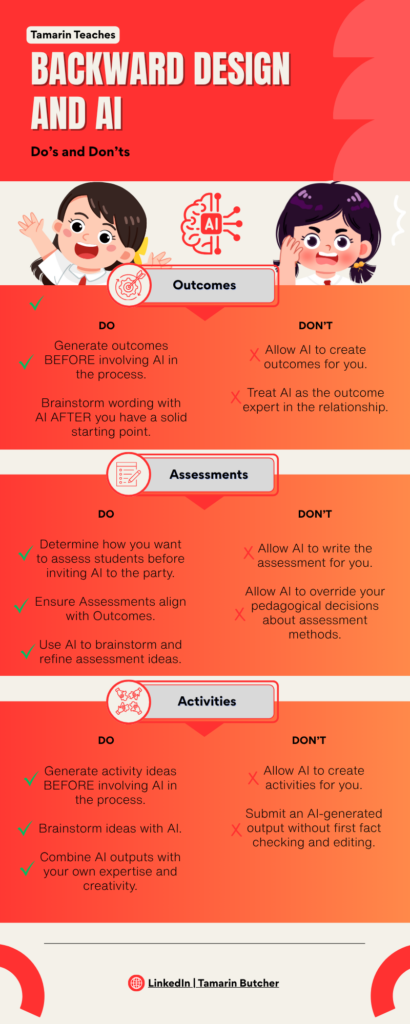
Outcomes are central to constructive alignment. As this is the most crucial step in the process, it is important that you generate outcomes FIRST, before involving AI in your course design process.
Once you have clear outcomes, discussed with all relevant stakeholders, you might ask AI for advice on stronger/clearer verbs.
Assessments
Without AI, determine how you would like to assess students in the course. Note all ideas, and the make sure they align with the outcomes you have already established. Create a first draft.
If you are short on ideas, use AI to brainstorm some options, but not to write the assessment. Once you have written a first draft of the assessment, you can ask AI to help you refine it. An AI output should not be used as a final product on its own.
Activities
Once you have your outcomes and assessments, create teaching and learning activities to support them using your own brain first. At a minimum, have a rough draft within a standard template that shows the required layout before you introduce AI into the activity.
Use AI to brainstorm ideas if you’re stuck and always remember to combine AI-generated outputs with your own expertise and creativity. Fact check and refine the content and remember that AI is there to enhance, not replace, your own judgement.
Take a look at this handy infographic for a summary of do’s and don’ts.